
Introduction
Teaching children about the prophets of Islam is one of the most rewarding things a parent or educator can do — but it can also feel overwhelming. Where do you start? How do you keep young minds engaged? And how do you make a story from the Quran feel real and relevant to a seven-year-old? Activities for kids about Prophet Adam (AS) offer the perfect entry point. As the first prophet and the first human being created by Allah, Prophet Adam’s story covers themes every child can relate to: obedience, making mistakes, feeling sorry, and being forgiven. It’s a story of creation, choice, and the mercy of Allah — and it’s one of the most detailed narratives in the Quran.
Whether you’re a homeschooling parent, a Sunday school teacher, or simply a Muslim family looking to bring Islamic education to life at home, this guide gives you everything you need. From hands-on crafts to discussion guides, worksheets, storytelling tips, and age-appropriate games, you’ll find practical, engaging activities that make learning about Prophet Adam (AS) genuinely exciting for children aged 3–12.
Who Is Prophet Adam (AS)? A Child-Friendly Overview
Before diving into activities, it helps to have a clear, age-appropriate summary of the story to work from.
Prophet Adam (AS) holds a unique place in Islamic faith as the first man and the first prophet sent by Allah. According to the Quran, Allah created Adam (AS) from clay and breathed His spirit into him. All the angels were commanded to prostrate to Adam as a sign of honor — and all obeyed, except Iblis (Shaytan), who refused out of arrogance and was expelled from Allah’s mercy.
Adam (AS) lived in Jannah (Paradise) with his wife Hawwa (Eve), where they enjoyed every blessing freely. Allah gave them one instruction: do not eat from a specific tree. Shaytan tempted them, they made the mistake, and they were sent to live on Earth — but crucially, they turned back to Allah in tawbah (sincere repentance), and Allah forgave them. This act of tawbah is one of the most powerful lessons in the entire story.
For children, this story teaches:
- Obedience to Allah even when temptation is present
- Tawbah — that sincere repentance is always accepted
- Humility — the danger of arrogance (as shown through Iblis)
- Human dignity — that Allah honored humanity from the very beginning
This narrative foundation, drawn from authentic sources including Ibn Kathir’s Stories of the Prophets, makes Prophet Adam’s story uniquely rich for educational activities across multiple learning styles.
Benefits of Using Activities to Teach Kids About Prophet Adam
Research consistently shows that children retain information far better when it’s delivered through multiple modes — storytelling, movement, art, and discussion. Islamic education is no different.
Here’s why activity-based learning works especially well for the story of Prophet Adam (AS):
- Emotional connection: Crafts and role-play help children feel the story rather than just hear it.
- Repetition without boredom: A child can hear the story, draw a scene, complete a worksheet, and play a game — all reinforcing the same core lessons without feeling repetitive.
- Value internalization: When a child discusses “What would YOU do if Shaytan tempted you?”, tawbah stops being an abstract concept and becomes a real moral framework.
- Multi-age inclusivity: Activities can be scaled from toddlers (coloring pages) to preteens (essay prompts and debate-style discussions).
✅ Expert Tip: According to UNICEF’s early childhood development research, children learn most effectively through play-based, hands-on experiences — making craft and game-based Islamic education not just fun, but developmentally optimal.
Top Activities for Kids About Prophet Adam (By Age Group)
Ages 3–5: Sensory and Visual Activities
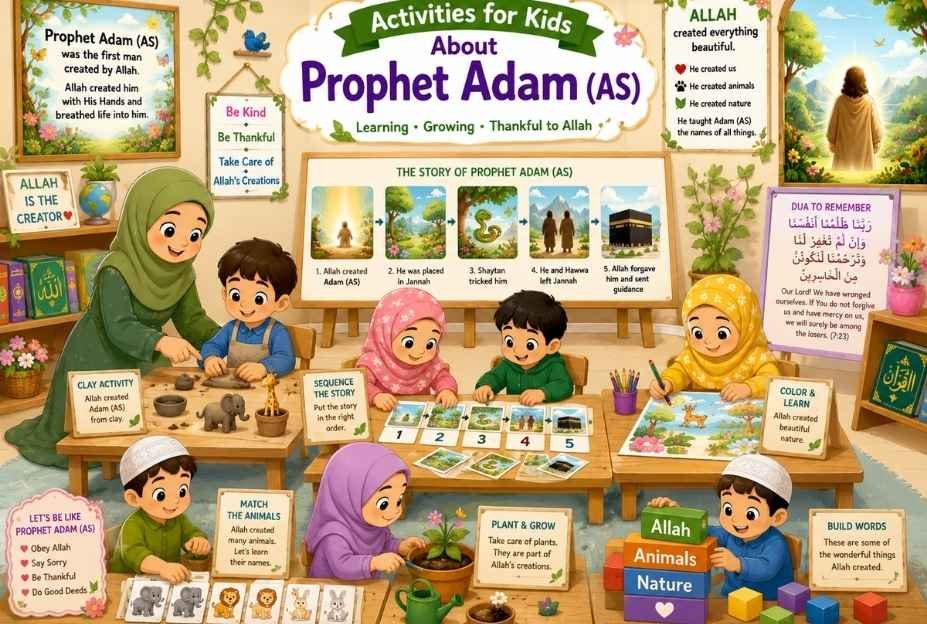
1. Clay Creation Activity
Connect directly to the Quranic narrative: Allah created Adam (AS) from clay. Give toddlers non-toxic modeling clay and ask them to shape a human figure. While they work, narrate the creation story simply: “Allah made the first man from clay, and then He breathed life into him.”
This tactile activity makes abstract concepts tangible and is deeply memorable for young children.
2. Jannah Collage
Ask children to imagine Jannah (Paradise) and create a collage using cut-out flowers, trees, fruits, and glittery stars. Discuss: “What do you think Jannah looks like? What would you want there?” This nurtures a love of Jannah and connects the child emotionally to the story’s setting.
3. Coloring Pages
Print or draw simple scenes from the story: Adam (AS) in Jannah, the angels prostrating, a tree (representing the forbidden one), and the Earth. Many free Prophet Adam coloring pages are available through Islamic education platforms. These work perfectly for nursery and Reception-age children.
Activities for Kids About Prophet Adam
Ages 6–9: Creative and Interactive Activities
4. Story Sequencing Cards
Write or print 6–8 key events from Prophet Adam’s story on separate cards. Shuffle them and ask children to arrange them in the correct order. Events might include:
- Allah creates Adam (AS) from clay
- Allah breathes His spirit into Adam
- Angels prostrate; Iblis refuses
- Adam lives in Jannah with Hawwa
- Iblis tempts Adam and Hawwa
- They eat from the tree
- Adam and Hawwa make tawbah
- Allah forgives them
This activity builds comprehension, sequencing skills, and story retention simultaneously.
5. The Tawbah Discussion Circle
Gather children and ask open questions:
- “Have you ever made a mistake? What did you do?”
- “Why do you think Allah forgave Adam and Hawwa?”
- “What is the difference between Adam (AS) and Iblis when they both disobeyed?”
This last question is particularly powerful — Adam repented; Iblis became arrogant. It draws out a nuanced moral lesson children will remember.
6. Prophet Adam Worksheet Pack
Worksheets are an excellent structured activity for home or classroom use. A well-designed Prophet Adam worksheet pack might include:
- True/False comprehension questions
- Fill-in-the-blank Quranic vocabulary
- A “Lessons I Learned” reflection page
- Arabic name colouring (آدم)
- A character comparison: Adam (AS) vs. Iblis
✅ Tip for Educators: Platforms like TeachersPayTeachers and Islamic education sites such as Teach Me Islam and Primary Ilm offer free and affordable Prophet Adam worksheet bundles. Always verify content against authentic Quranic sources.
7. “What Would You Do?” Scenario Game
Present children with simple moral dilemmas inspired by the story:
- “You’re told not to open a box. A friend says it’s okay. What do you do?”
- “You made a mistake. Do you say sorry to Allah? How?”
This encourages practical application of tawbah and obedience — translating Quranic lessons into real-life behavior.
Ages 10–12: Reflective and Research-Based Activities
8. Prophet Adam (AS) Mini Research Project
Assign older children a structured research project:
- Who is Prophet Adam? (Creation narrative)
- What does the Quran say? (Reference specific Surahs: Al-Baqarah, Al-A’raf, Al-Hijr)
- What lessons do we take? (Tawbah, humility, trust in Allah)
- How does this connect to my life? (Personal reflection)
Encourage use of Islamic reference books and age-appropriate Quran translations. This builds research skills alongside Islamic knowledge.
9. Angels vs. Iblis Debate Activity
Split the class or siblings into two groups. One group argues from the perspective of the angels who obeyed; the other explores why Iblis thought he was right (without endorsing it) — and then the group discusses what went wrong in Iblis’s reasoning (arrogance, comparison, disobedience).
This higher-order thinking activity is excellent for Sunday school classes and Islamic homeschool groups.
10. Creative Writing: A Letter from Adam (AS)
Ask children to write a short letter in the voice of Prophet Adam (AS), reflecting on his experience:
- What did he feel in Jannah?
- What happened when he was tempted?
- What did tawbah feel like?
- What message would he give to us?
This creative writing task builds empathy, comprehension, and genuine connection to the prophetic narrative.
Structuring a Full Lesson Plan Around Prophet Adam (AS)
Here’s a simple 60-minute session structure that works for homeschool parents, weekend Islamic school teachers, and community educators:
| Time | Activity | Age Adaptation |
|---|---|---|
| 0–10 min | Read-aloud or video: Story of Prophet Adam | Simplify for ages 3–6 |
| 10–20 min | Discussion questions (tawbah, obedience) | Open-ended for older kids |
| 20–35 min | Core activity (clay, worksheet, sequencing) | Age-matched from above |
| 35–50 min | Creative output (drawing, writing, collage) | Freestyle for younger |
| 50–60 min | Wrap-up: One lesson I’ll take home today | Verbal or written |
✅ Did You Know? The story of Prophet Adam (AS) appears in multiple surahs of the Quran, including Surah Al-Baqarah (2:30–39), Surah Al-A’raf (7:11–25), and Surah Al-Hijr (15:26–44). Introducing children to these references early builds lifelong familiarity with Quranic navigation.
Common Mistakes Parents and Teachers Make
Even well-intentioned Islamic educators fall into a few predictable traps when teaching Prophet Adam’s story:
1. Overcomplicating theological details
Young children don’t need a full discussion of Islamic theology on free will and divine decree. Focus on the story’s core: creation, test, mistake, repentance, forgiveness.
2. Making Iblis “scary” without context
Some well-meaning adults unintentionally create fear-based associations. Instead, use Iblis’s story as a lesson in what arrogance and disobedience lead to — not a bogeyman narrative.
3. Teaching without reflection
Simply telling the story isn’t enough. Always include a “What did we learn?” moment. Children internalize lessons through discussion, not passive listening.
4. One-size-fits-all delivery
A three-year-old and a ten-year-old need completely different approaches. Use the age-segmented activities in this guide to meet each child where they are.
5. Skipping the tawbah lesson
Many educators focus on the “mistake” (eating from the tree) and forget that the heart of the story is tawbah — that sincere repentance is always accepted. This is the most life-relevant lesson for children.
Recommended Resources for Teaching Prophet Adam (AS)
Books:
- Stories of the Prophets by Ibn Kathir (retold at child-appropriate level)
- My First Quran Storybook by Saniyasnain Khan (ages 4–8)
- Prophets of Islam series for early readers
Online Platforms:
- Teach Me Islam (teachmeislam.org) — free worksheet library
- Primary Ilm (primaryilm.com) — structured prophet story packs
- Barakah Blooms (barakahblooms.com) — illustrated slides and parent guides
Videos:
- Zaky & Friends animated series (One4Kids) — covers prophets’ stories with age-appropriate visuals
- Various Quran story animations on YouTube (verify Islamic accuracy before sharing)
FAQ
Q: Who is Prophet Adam in Islam, and why is his story important for kids?
Prophet Adam (AS) is the first human being and first prophet in Islam, created by Allah from clay. His story teaches children about creation, obedience, the danger of arrogance, and the power of sincere repentance (tawbah). It’s foundational to Islamic belief and a natural starting point for a child’s Islamic education.
Q: At what age should children be taught about Prophet Adam?
Children can be introduced to Prophet Adam’s story as early as age 3 through simple storytelling and coloring activities. By ages 6–9, they can engage with worksheets and discussions. Preteens (10–12) are ready for reflective writing, research projects, and deeper moral analysis.
Q: What crafts work best for teaching Prophet Adam’s story?
The clay creation activity is the most thematically connected craft — since Adam (AS) was created from clay. Jannah collages, story sequencing cards, and coloring pages are also highly effective for younger children.
Q: Are there free Islamic worksheets about Prophet Adam available?
Yes. Teach Me Islam and Primary Ilm both offer free downloadable worksheets about Prophet Adam (AS) covering comprehension questions, Arabic vocabulary, and reflection prompts. TeachersPayTeachers also has affordable paid bundles.
Activities for Kids About Prophet Adam
Q: What is the most important lesson children should take from Prophet Adam’s story?
The lesson of tawbah (sincere repentance) is arguably the most important. Prophet Adam (AS) made a mistake, immediately turned back to Allah with a sincere heart, and was forgiven. This teaches children that mistakes don’t define them — their response to mistakes does.
Q: How long should a lesson about Prophet Adam be for young children?
For children under 6, keep sessions to 15–20 minutes maximum, combining storytelling with one simple activity. For ages 6–12, a 45–60 minute structured session with varied activities maintains engagement effectively.
Q: Can the story of Prophet Adam be taught in non-Muslim schools?
Yes, in the context of world religions or comparative religious education. The story aligns with Abrahamic traditions and raises universal themes — creation, free will, moral choice, and forgiveness — that are relevant in any educational setting.
Conclusion
Activities for kids about Prophet Adam (AS) are one of the most powerful tools in any Islamic educator’s toolkit. The story is simple enough for a three-year-old to grasp and deep enough for a twelve-year-old to reflect on for years. By combining age-appropriate storytelling with hands-on crafts, structured worksheets, discussion circles, and creative writing, you give children not just knowledge of the first prophet — but a genuine connection to the Quran, to Islamic values, and to the mercy of Allah.
Start small: read the story aloud, do the clay activity, ask one discussion question. Build from there. The goal isn’t to teach everything at once — it’s to plant seeds of love for the prophets of Islam that will grow throughout your child’s life.
For more Islamic education resources, printable worksheets, and age-appropriate lesson plans covering all the prophets of Islam, explore the trusted platforms referenced throughout this guide. May Allah make it easy for every parent and teacher striving to raise children who love their deen.